Forward sensor nodes that move with the force.
A sensor-node architecture for fixed sites and mobile operations.
SCOUT defines the forward sensor-node role: partner hardware on a tripod or vehicle, with an interface to the decision layer. Placement and communications are shaped around the site, terrain and operator’s task.
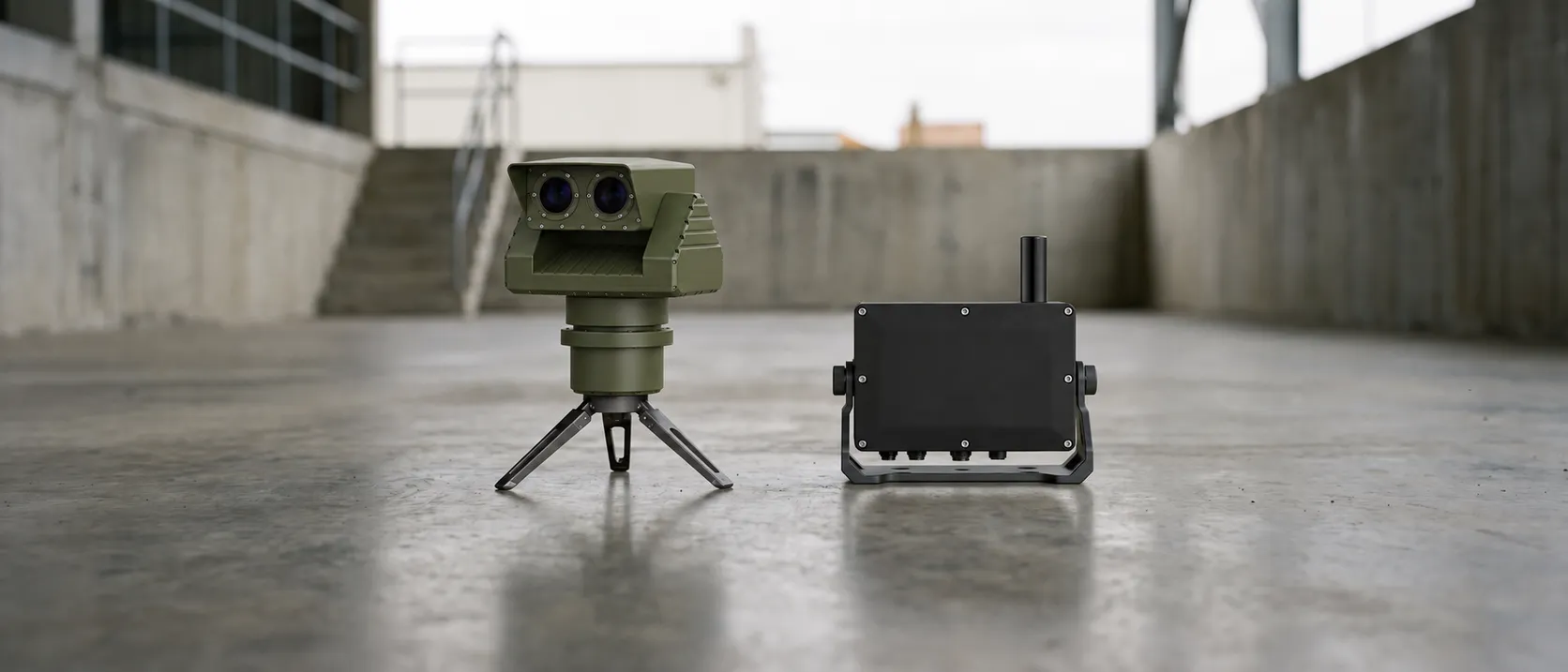 AI illustration · product concept
Distributed. Forward. Connected.
Forward nodes are intended to extend observation beyond a fixed site. Coverage, network behaviour and scaling remain to be tested.
- Designed for distributed forward nodes.
- Planned mesh link via NEXUS.
- Intended for mobile and forward use.
- Designed to scale from one node to a network.
- Designed to carry partner-supplied or third-party sensor packages.
In the decision loop.
Multi-sensor detection: radar, passive RF and EO/IR — partner-supplied sensors integrated by VAERN, or the sensors already on site.
NEXUS is designed to link forward nodes into one network.
Explainable edge AI fuses sensors and classifies tracks.
The operator sees one air picture and authorises the response.
Capture nets, kinetic interceptors and RF jammers — supplied by authorised partners under their own authorisations and used only where the law allows. VAERN does not manufacture effectors.
Details.
| Form factor | Distributed forward nodes |
| Connectivity | Planned: NEXUS mesh |
| Deployment | Mobile / forward — field or temporary setup |
| Specifications | Specified per deployment |
Figures are set per deployment — every site gets the mix it needs, and we publish no numbers we cannot stand behind.
Forward nodes widen the picture — the human authorisation stays central, at HAMMER.